
A missing tooth can change more than your smile. You may start chewing on one side, avoid certain foods, or feel self-conscious when speaking or laughing. When considering partial dentures versus dental bridges, the better choice is rarely about picking the “best” treatment in general. It is about choosing the restoration that fits your mouth, your remaining teeth, and the way you want to care for your smile every day.
Both options can replace missing teeth and restore confidence. However, they work very differently. A careful dental examination, including X-rays when needed, helps determine whether your gums, supporting bone, and neighboring teeth are suitable for either treatment.
How Partial Dentures Work
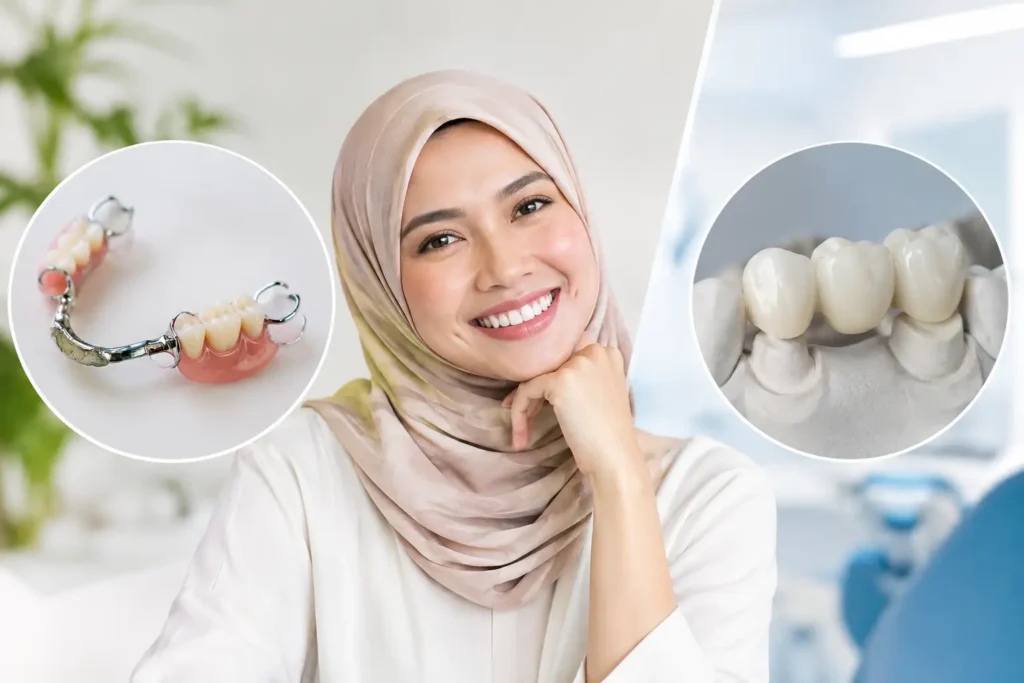
A partial denture is a removable appliance designed to replace one or several missing teeth. It has replacement teeth attached to a gum-colored base, usually supported by a lightweight metal or flexible framework. Small clasps may hold it around selected natural teeth so it stays in position during normal use.
Partial dentures are often useful when several teeth are missing in different areas of the mouth. Rather than restoring each gap separately, one appliance can replace multiple teeth. They can also be a practical option when the teeth beside a gap are not strong enough or appropriately positioned to support a bridge.
Because the appliance is removable, you take it out at night and clean it separately. This may take an adjustment period, especially during the first few weeks. Speech can feel slightly different at first, and some patients notice more movement than they expected while eating. A well-made, well-fitted partial denture should become more comfortable with time, but it will still feel different from natural teeth.
When a Partial Denture May Be a Good Fit
A partial denture may be recommended when you have multiple missing teeth, gaps on both sides of the mouth, or a need for a more conservative treatment that does not require reshaping neighboring teeth. It can also be a suitable temporary solution while you consider a longer-term option, such as implant-supported treatment.
The condition of your remaining teeth matters greatly. Healthy teeth and gums give a partial denture better support. If gum disease, decay, or loose teeth are present, these concerns should be treated first. Replacing missing teeth is most successful when it is part of an overall plan for long-term oral health.
How Dental Bridges Work
A dental bridge is a fixed restoration. It replaces a missing tooth by connecting an artificial tooth to crowns placed on the teeth beside the gap. Once cemented, a traditional bridge stays in your mouth and is not removed for daily cleaning.
For many patients, a bridge feels more secure than a removable partial denture. It may be easier to chew with, and it usually feels more natural after the adjustment period. Bridges can be especially helpful for a single missing tooth or a short gap where there are healthy, strong teeth on both sides.
A conventional bridge does require preparation of the supporting teeth. Your dentist shapes these teeth so crowns can fit over them. This is an important trade-off. If the neighboring teeth already have large fillings, crowns, or damage, using them to support a bridge may make practical sense. If they are completely healthy and untouched, your dentist may also discuss alternatives that preserve them.
What to Expect From Bridge Treatment
Bridge treatment commonly takes more than one visit. During the first visit, the supporting teeth are prepared and a digital or physical impression is taken. A temporary bridge may be placed while the final restoration is being made. At the fitting appointment, your dentist checks the shape, color, bite, and comfort before securing the bridge.
A bridge needs thoughtful cleaning because plaque can collect beneath the replacement tooth. A regular toothbrush alone cannot reach every area under a bridge. Your dentist may recommend floss threaders, special bridge floss, or an oral irrigator to help keep the supporting teeth and gums clean.
Partial Dentures Versus Dental Bridges: Key Differences
The largest difference is that a partial denture is removable, while a dental bridge is fixed. That distinction affects comfort, maintenance, cost, and treatment planning.
A bridge often feels more stable because it does not come out. Many patients prefer the convenience of brushing it as part of their usual routine. However, it relies on the teeth beside the gap. Those supporting teeth must be healthy enough to carry the extra load, and they require excellent cleaning to prevent decay or gum problems around the bridge margins.
A partial denture does not require permanently altering nearby teeth in the same way. It can replace more teeth across a wider area, which can make it more versatile in complex cases. On the other hand, it needs to be removed, cleaned, and stored properly. It may also need adjustments over time as your gums and jawbone naturally change shape.
Cost can differ depending on the number of teeth being replaced, the materials selected, the condition of your existing teeth, and any preparatory treatment required. A partial denture may have a lower initial cost in some cases. A bridge may involve a greater upfront investment but offers the benefit of a fixed restoration. The most useful comparison is not just the initial fee, but the expected maintenance and likely longevity for your specific situation.
Comfort, Appearance, and Daily Life
Comfort is personal. Some patients find a bridge more natural because it is fixed in place. Others appreciate that a partial denture can be removed for cleaning and gives them a way to replace several teeth without extensive work on surrounding teeth.
Appearance also depends on the design. Modern dental materials can create natural-looking replacement teeth, but careful planning matters. The shade, shape, gum contours, and position of the teeth all influence the result. If a partial denture uses visible clasps, this may be a concern for teeth near the front of the mouth. Your dentist can explain design options and what will be visible when you smile.
Eating habits deserve an honest discussion as well. A bridge may provide stronger chewing confidence for a short gap, provided the supporting teeth are sound. With a partial denture, it is usually best to begin with softer foods and chew evenly on both sides as you adapt. Very sticky or hard foods can dislodge or damage either type of restoration.
The Role of Your Gum and Bone Health
Missing teeth can lead to gradual changes in the jawbone and shifting of nearby teeth. Neither a traditional partial denture nor a conventional bridge replaces the tooth root, so neither fully prevents bone changes below the gap. This does not mean they are poor choices. Both can be effective restorations when properly planned and maintained.
It does mean that dental implants may enter the conversation for some patients. An implant supports a replacement tooth from within the jaw and can avoid relying on adjacent teeth. Yet implants are not automatically the right answer for everyone. Bone volume, medical history, healing, treatment timeline, and budget all need to be considered.
Before deciding, your dentist should check for gum inflammation, untreated cavities, bite concerns, and signs of teeth grinding. A restoration lasts longer when the foundation around it is healthy.
Caring for Your New Smile
Daily care protects your investment. A partial denture should be removed and brushed gently with a denture cleanser or product recommended by your dentist. Do not use hot water, as it can distort the material. Clean your natural teeth, gums, and tongue before putting it back in.
A bridge should be brushed twice daily with fluoride toothpaste, with special attention to the gumline and the area underneath the replacement tooth. Regular dental visits remain essential for both options. Your dentist can check the fit, bite, gums, and supporting teeth before a small issue becomes a larger problem.
If your partial denture becomes loose, cracks, or causes sore spots, do not try to adjust it yourself. If a bridge feels high when biting, becomes loose, or causes persistent sensitivity, arrange a dental review promptly.
The right restoration should help you eat, speak, and smile with less worry – not add another source of discomfort. At Ideal Smile, a consultation can clarify what your teeth need now and what will best support your oral health in the years ahead.
