
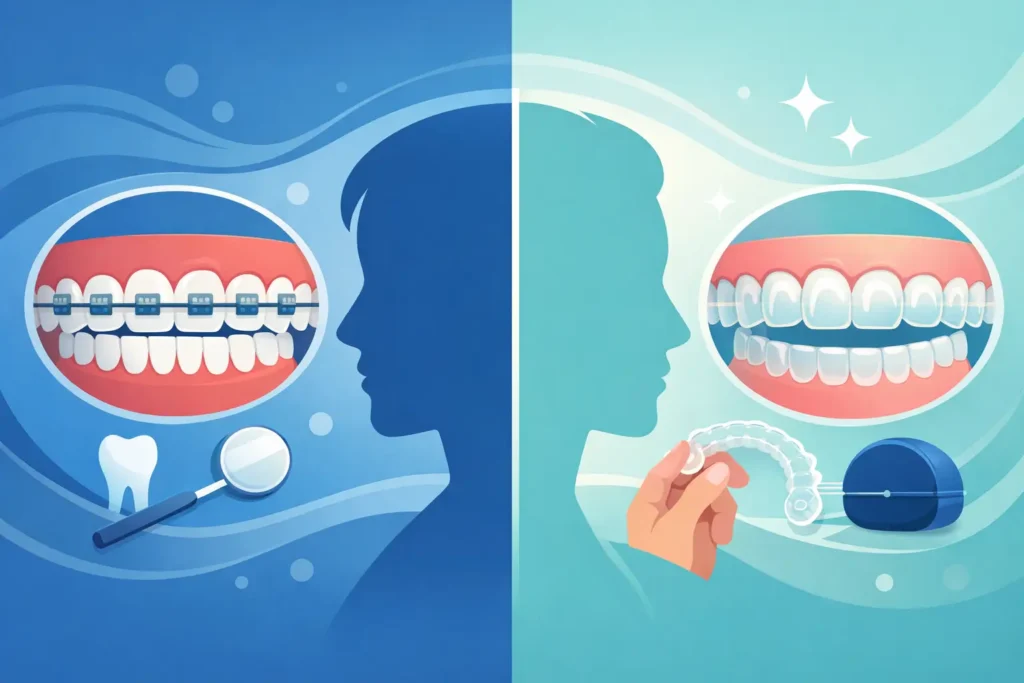
A straighter smile is exciting until you reach the part where you have to choose between braces vs clear aligners. For many patients, that decision is not really about looks alone. It is about daily comfort, how much discipline treatment requires, how complex the tooth movement is, and what kind of result is most realistic for your smile.
Both options can be excellent. Both can improve bite alignment, crowding, spacing, and overall smile confidence. But they work differently, and the best choice often depends on your teeth, your habits, and your priorities.
Braces vs clear aligners: the real difference
Traditional braces use brackets and wires that stay fixed on the teeth throughout treatment. Your dentist or orthodontic provider adjusts them over time to guide teeth into better positions. Because they are attached to the teeth, braces work continuously.
Clear aligners are removable trays made to fit closely over the teeth. Each set is designed to make small planned movements, and you switch to new trays as treatment progresses. They are far less noticeable than braces, which is why many adults and teens ask about them first.
That difference – fixed versus removable – affects almost everything else, from comfort to convenience to treatment success.
Appearance and confidence in daily life
If appearance is a major concern, clear aligners usually have the advantage. They are discreet and often hard to notice at a conversational distance. Many working adults and older teens prefer them because they feel more comfortable smiling in meetings, photos, or social settings.
Braces are more visible, even when smaller or more modern brackets are used. Some patients do not mind that at all, especially children and teenagers. Others feel self-conscious during the first few months.
Still, appearance should not be the only deciding factor. A less visible option is only better if it can actually treat your case well and if you are likely to wear it as instructed.
Comfort and adjustment period
Neither braces nor clear aligners are completely pain-free. Teeth need pressure to move, so some soreness is normal with both options.
Braces can cause irritation on the cheeks and lips, especially early on or after adjustments. Broken wires or loose brackets can also create discomfort and may need an extra dental visit. On the other hand, once braces are on, there is nothing to remember. They keep working whether you are busy, tired, or forgetful.
Clear aligners usually feel smoother because there are no brackets or wires rubbing the mouth. Many patients find them more comfortable overall. But each new tray can create pressure for a day or two, and removing them when teeth are sore can feel unpleasant, especially at the start.
Comfort also depends on personality. Some people prefer a fixed system they do not have to think about. Others strongly prefer something removable and lower profile.
Treatment complexity and who each option suits best
This is where the conversation becomes more clinical. Not every case is equally suited to clear aligners.
Braces are often better for more complex orthodontic problems. That includes significant crowding, rotated teeth, larger bite issues, and movements that require very controlled force. Because braces are fixed and highly adjustable, they can be more predictable in these situations.
Clear aligners can work very well for mild to moderate crowding, spacing, and many cosmetic alignment concerns. They can also treat some more involved cases, but success depends on careful planning and patient compliance. In some situations, attachments on the teeth or other aids are needed to help the aligners grip and move teeth properly.
This is why an in-person assessment matters. Two people may both want straighter front teeth, but one may also have a deeper bite, jaw alignment issue, or tooth rotation that changes the best treatment choice.
Braces vs clear aligners for lifestyle
Lifestyle is one of the biggest deciding factors, and it is often underestimated.
Braces are simpler in one important way: they are always on. You do not need to remember to wear them, carry them, or remove them before meals. That makes them a strong choice for younger patients or adults who know they do not want the responsibility of managing aligners.
But braces come with food restrictions. Hard, sticky, and chewy foods can damage brackets or wires. Cleaning also takes more effort because food tends to get trapped around the hardware.
Clear aligners offer more freedom at mealtimes. You remove them to eat and drink anything other than water, so there are no bracket-friendly food rules. Brushing and flossing are often easier too because you clean your teeth normally once the trays are out.
The trade-off is consistency. Clear aligners need to be worn for most of the day, often around 20 to 22 hours. If you frequently leave them out, treatment may slow down or stop tracking properly. For patients with busy routines, frequent snacking, or a tendency to misplace things, that can become a real problem.
Oral hygiene and dental health during treatment
Straightening teeth should support oral health, not make it harder to maintain.
Braces can make brushing and flossing more time-consuming. If plaque builds up around brackets, there is a higher risk of gum irritation, cavities, and staining. Good technique and regular dental visits become especially important during treatment.
Clear aligners can make oral hygiene more manageable because they are removable. You can brush and floss as usual before putting the trays back in. That said, aligners are not maintenance-free. If they are worn over unclean teeth, bacteria and food residue can stay trapped against the enamel for long periods.
For patients already prone to plaque buildup or inconsistent home care, either option requires commitment. The difference is that braces make cleaning physically harder, while aligners make discipline more important.
How long treatment takes
Treatment time varies with the complexity of the case, not just the appliance.
Some mild cases with clear aligners may move efficiently and finish within a relatively short period. Some brace cases also progress quickly. More complex issues can take much longer with either system.
Where aligners can lose time is wear compliance. If trays are not worn enough, teeth do not move as planned, and refinements may be needed. Braces avoid that specific issue because the system is fixed.
In other words, clear aligners may feel more convenient, but they only stay efficient if the patient follows instructions closely.
Cost and value
Patients often ask which option is cheaper. The honest answer is that cost varies by provider, case complexity, treatment length, and the type of system used.
Braces and clear aligners can sometimes fall into a similar price range. In other cases, clear aligners may cost more, especially if treatment planning is more customized or multiple refinement stages are needed.
Value matters more than headline cost. If clear aligners fit your lifestyle and you will wear them faithfully, they may be worth it. If braces are more likely to achieve a reliable result in your case, they may offer better long-term value even if the upfront numbers are similar.
A good treatment recommendation should never be based on trend alone. It should be based on what will move your teeth safely and predictably.
Which option is better for teens and adults?
Adults often lean toward clear aligners because they are discreet and easier to fit into professional and social life. That preference makes sense. Still, adults with more complex bite concerns may be better served by braces, at least in some phases of treatment.
For teens, the choice depends a lot on maturity and routine. A responsible teen who will wear aligners properly may do very well with them. A teen who tends to forget retainers, sports gear, or school items may be a better candidate for braces simply because braces remove the daily decision-making.
Parents sometimes assume aligners are automatically easier for younger patients, but that is not always true. Removable treatment works best when the patient is ready for that responsibility.
How to decide between braces vs clear aligners
The best decision usually comes from balancing three things: clinical need, personal habits, and treatment goals.
If your case is complex, if you want the most hands-off option, or if compliance may be an issue, braces may be the stronger choice. If your alignment concerns are suitable for trays, appearance matters a lot to you, and you are confident you can wear them consistently, clear aligners may be an excellent fit.
At a clinic such as Ideal Smile, this decision should start with a careful exam, not a quick guess. A proper assessment can show whether your teeth need more controlled movement, whether aligners are realistic for your bite, and what kind of timeline to expect.
Choosing orthodontic treatment is not about picking the more popular option. It is about choosing the one you are most likely to complete well, so your smile ends up healthier, more balanced, and easier to maintain for years to come.
